
Check Issaquah Voter Registration
Issaquah voters have two free self-service choices. The VoteWA voter portal is the state voter and ballot-management system. It requires an exact first name, exact last name, and full date of birth. The King County My Voter Information lookup accepts any three of four identifiers. Both are authentication tools for checking one’s own record, not open surname indexes.
Start with the state portal when all registration details are known. If VoteWA rejects a spelling or the first name is uncertain, try the county form with the last name, birth date, and house number. A voter with only one legal name should place it in the county form’s Last name field. The county updates voter information nightly and ballot status hourly from 8 a.m. through 8 p.m.
| Official lookup | Field | Requirement | Entry notes |
|---|---|---|---|
| VoteWA | First name | Required | Must match the official record |
| VoteWA | Last name | Required | Must match the official record |
| VoteWA | Date of birth | Required | Use mm/dd/yyyy |
| King County | First name | Any 3 of 4 | Must match the record if used |
| King County | Last name | Any 3 of 4 | Use this field for a single legal name |
| King County | Date of birth | Any 3 of 4 | Use mm/dd/yyyy |
| King County | House or building number | Any 3 of 4 | Enter the numeric street number |
The county voter lookup screen shows how the four-field fallback is arranged.
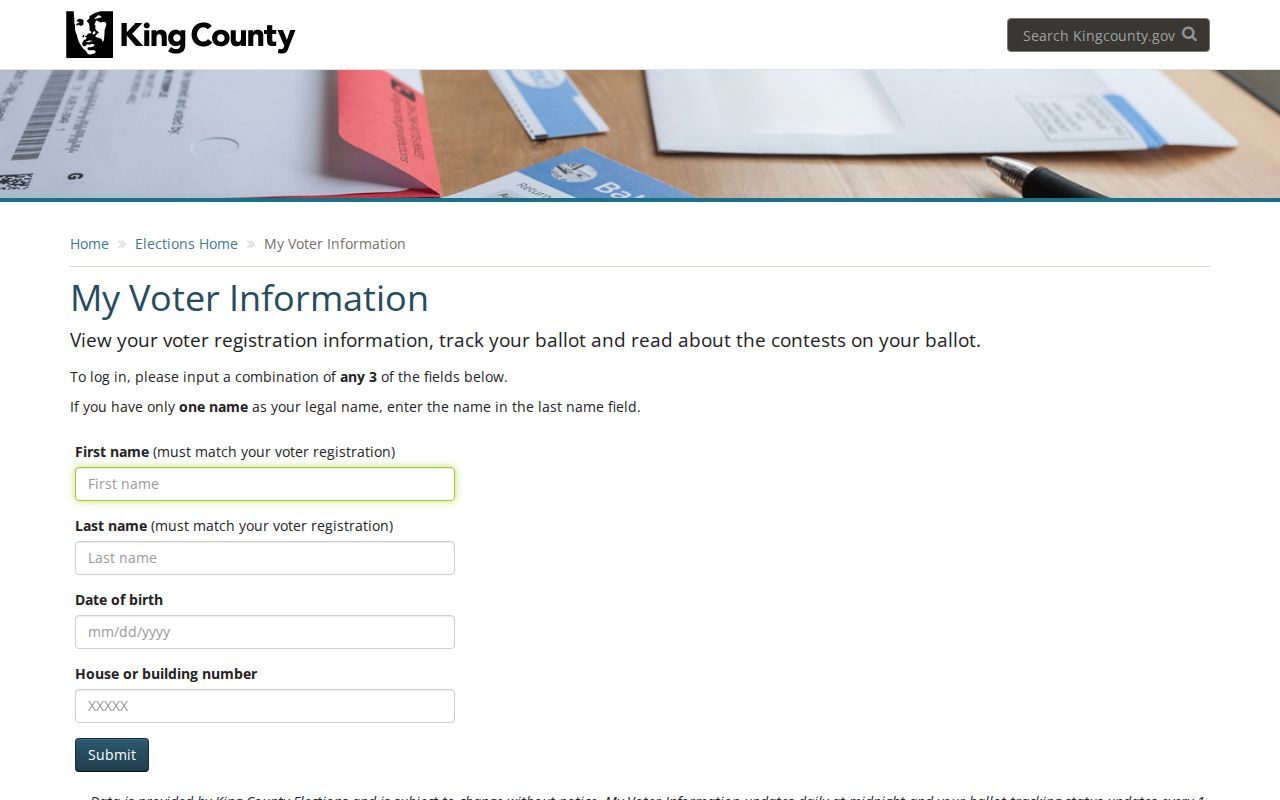
Its any-three rule is the key distinction from VoteWA’s three required fields and can save a call when the registered first-name form is unclear.
Note: A failed login does not prove that a registration is absent; name form, address changes, and data-update timing can affect the match.
Issaquah Voter Records Fields
Washington law separates a public voter record from the fuller administrative database. Under RCW 29A.08.710, the public portion includes name, address, political jurisdiction, gender, year of birth, voting record, registration date, and registration number. Washington does not register voters by political party. The voting record reports participation, never the choices marked on a ballot.
The statewide extract expands those categories into columns used for sorting and matching. Address data is split into house number, fraction, street name and type, directional parts, unit, city, state, and ZIP code. Political geography includes county, precinct, legislative district, and congressional district. Mailing fields can differ from residence fields. The registration section includes the state voter ID, registration date, last-voted date, and status code.
| Identity | Name parts, suffix, year of birth, gender, and state voter ID |
|---|---|
| Residence | Street components, unit, city, state, and ZIP code, unless protected |
| Districts | County, precinct, legislative district, and congressional district |
| Mailing | Mailing-address lines, city, state, ZIP code, and country |
| Voter activity | Registration date, last-voted date, and status code |
| Party and ballot choice | Not included; Washington has no party registration and voting history shows participation only |
Private Washington Voter Records
Authentication data is not the same as public data. A full birth date may be needed to enter an official portal, but the public voter file supplies only the year. Original registration forms are confidential. Full birth dates, signatures, identification or Social Security number digits, supplied phone numbers and email addresses, and the agency where a person registered are excluded from the public extract.
Confidential by Washington law. RCW 29A.08.710 limits public voter data, while RCW 40.24.060 protects Address Confidentiality Program records. A login credential does not become a public field.
Future-voter information also has separate disclosure limits under RCW 29A.08.725. These rules matter when comparing a self-service result, a voter-file extract, and a county office record. Each source can lawfully show a different slice of the same registration.
Request Washington Voter Registration Data
The Secretary of State voter-database extract form supplies all active registered voters, current and prior-year voting history, and district or precinct data. Any requester may apply, but must accept the statutory use limits. The current web delivery is free. A request can cover Washington or one county; choose King County for an Issaquah-focused file, then filter by city, precinct, or district.
- Enter the requester’s name, email, phone, street address, city, state, and ZIP code.
- Select one file scope. Choose King County for local voter rolls or the statewide option for broader work.
- Accept the agreement tied to RCW 29A.08.720, RCW 29A.08.740, and RCW 42.56.070(8), then submit.
- Use the emailed download link after approval. Requests may take up to five business days, though the state says most are filled at once.
The ZIP package has four parts: the VRDB Extract, Voting History Extract, Districts to Precincts, and a restricted-use notice. The data files use vertical bars between fields. District analysis requires joining the precinct crosswalk to the main database. Election-level participation requires the separate history file. Washington began collecting voting dates in 2006, and older imported history varies by county.
Issaquah Voter Roll Limits
Public access does not create a right to use voter rolls for any purpose. RCW 29A.08.720 bars use of voter lists to mail or deliver advertisements, offers, or solicitations for money, services, property, products, establishments, or organizations. The law permits defined political purposes, such as support for or opposition to a candidate or ballot question. RCW 42.56.070(8) also generally bars agencies from supplying lists of individuals for commercial purposes.
Misuse has serious consequences. RCW 29A.08.740 classifies prohibited use as a class C felony, with a possible term of up to five years, a fine of up to $10,000, or both. The law also creates civil liability of $5 per item and can reach a recipient who failed to take reasonable precautions. Never use voter information to stalk, threaten, or harass a person.
Does voting history reveal a vote? No. It can show that someone took part in an election, but it never reveals selections on a ballot and should not be treated as a perfect turnout count.
King County Voter Records Desk
King County Elections administers Issaquah voting from 919 Southwest Grady Way, Renton, WA 98057. Voter services can be reached at 206-296-VOTE (8683), elections@kingcounty.gov, or TTY Relay 711. The office handles local election data, maps, results, and records routes. Statewide voter database requests now belong with the Secretary of State extract rather than a county copy process.
The official elections page presents the county’s main service and request paths.
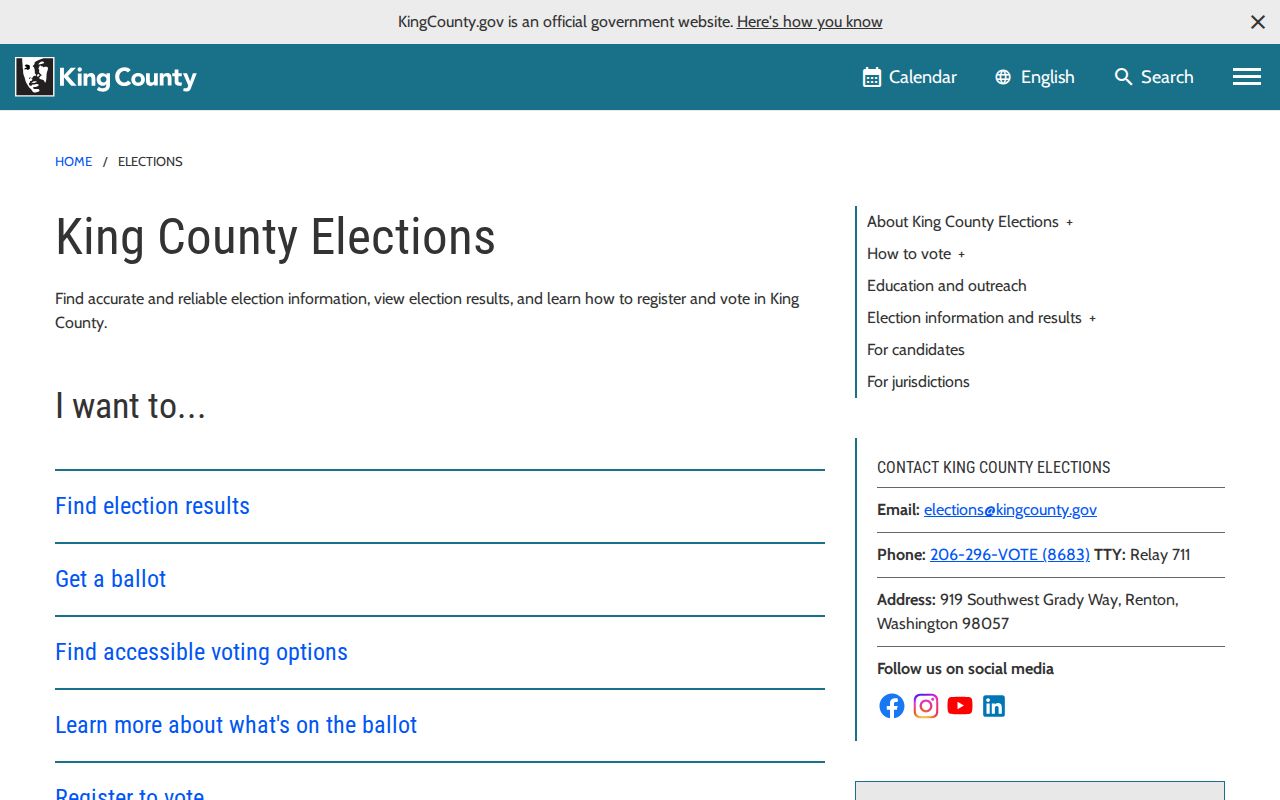
That county hub is the right fallback for an unresolved registration issue, local election data, or a records question that the self-service voter lookup cannot answer.
King County Elections
919 Southwest Grady Way
Renton, WA 98057
206-296-VOTE (8683)
elections@kingcounty.gov
Washington Elections Data
Statewide VRDB extract requests
electionsdata@sos.wa.gov
360-902-4194
Free emailed download after approval
Issaquah Voter Status Changes
Active, inactive, and cancelled are distinct status states. Address evidence or an undeliverable ballot can begin the confirmation process and lead to inactive status under RCW 29A.08.620. Contact or voter activity can restore active status. RCW 29A.08.630 permits cancellation only after the statutory inactive period, so an inactive label does not mean the record vanished at once.
Death and felony-disqualification matching follow documented checks. Washington receives death data each month from health authorities and the Social Security Administration, while county staff research possible matches. Written family notice and obituaries can also be used. Corrections data is matched by name and birth date, followed by a letter and a 30-day chance to dispute before cancellation.
RCW 29A.08.770 requires two years of retention and public access for list-accuracy program records, including notice names and addresses, responses, removals, and reasons, subject to future-voter limits. King County’s final November 2025 election results listed 24,686 registered voters in Issaquah and 11,529 ballots counted, a 46.70 percent turnout.
Note: County lookup data refreshes nightly, so a recent registration or address update may not appear in the same day’s result.
Protected Issaquah Voter Registration
Washington created the nation’s first Address Confidentiality Program in 1991. It provides a substitute address and confidential mail forwarding as part of a safety plan for eligible survivors and household members, as well as certain threatened public workers. Certification normally lasts four years.
A Protected Records Voter uses the program’s special registration form, not VoteWA or another standard registration channel. The actual address, name, county, and precinct stay out of the public VoteWA record. Protected details can include residence and mailing addresses, the city and county of residence, precinct, and unique facts tied to home, work, or school. The substitute address and Washington residence remain nonconfidential.
The program cannot normally erase records made public before enrollment. Federal agencies and private firms are not generally required to accept the substitute address either. These boundaries make early use of the program important for someone who qualifies.
Historical Issaquah Voter Registers
Current portals do not cover the whole story. King County Elections retains voter information from 1995 to the present. For older research, Puget Sound Regional Archives holds King County registration lists from 1884 through 1934, arranged by precinct or ward. Exact coverage for an Issaquah or Gilman precinct must be confirmed with archive staff.
Fields vary by year. A historical register may give a name, registration date, age, birthplace, time in the precinct, occupation, and naturalization date or court. Those details can support family history and help distinguish people who shared a name. They should not be expected in a modern lookup, which was designed for current registration and ballot service.
The place name matters too. Gilman incorporated in 1892, and the town adopted Issaquah in 1899. Search both names when reviewing nineteenth-century voter records. A blank result in a current portal says nothing about the archive’s older precinct books.